
The Engineering Challenge of Live Presentation
Building an autonomous live presenter is fundamentally different from wrapping a large language model in a browser chat interface. Text chat is asynchronous and forgiving; users tolerate multi-second latency between message generation and rendering.
A live spoken presentation, by contrast, operates under unforgiving real-time physics. If an attendee interrupts with a spoken question and the system pauses for two seconds before responding, the illusion of human presence shatters. If slide animations fall out of synchronization with vocal syllables by even a few hundred milliseconds, comprehension degrades. And if the presenter hallucinates a fictional compliance certification, the commercial ramifications are immediate and severe.
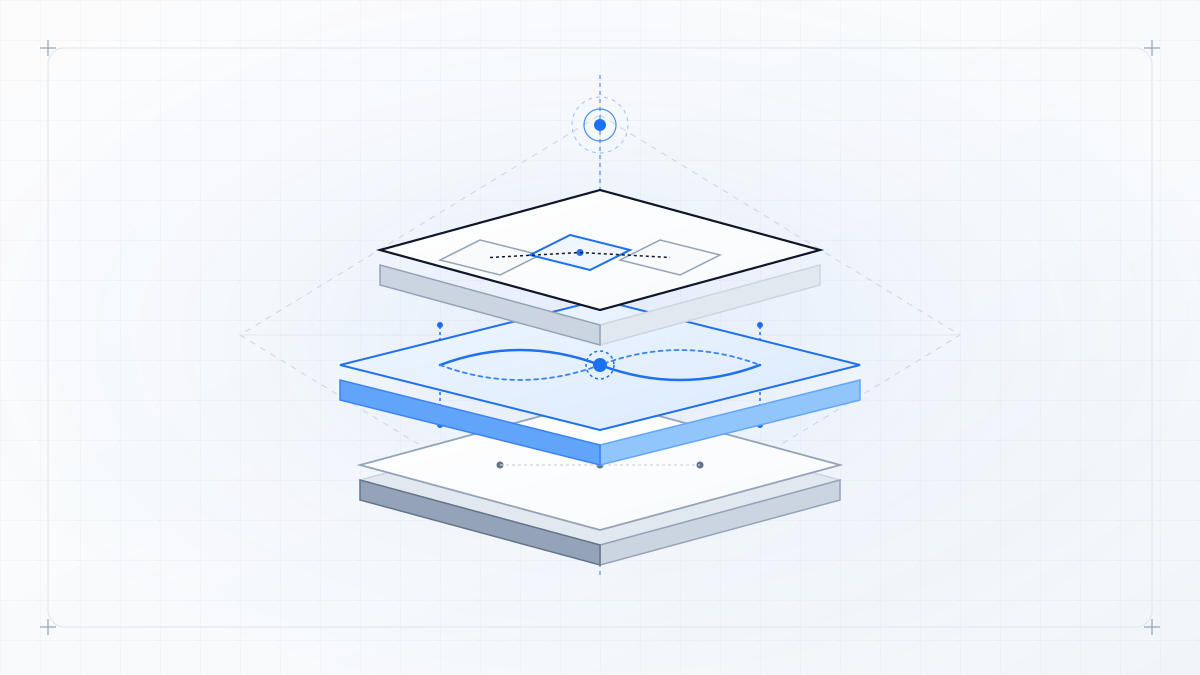
To turn the presenter role into reliable software infrastructure, Seminara designed a three-pillar technical architecture: an ultra-low-latency WebRTC voice pipeline, a deterministic Finite State Machine (FSM) for slide state management, and strict vector citation grounding.
Sub-Second Voice Pipeline and Client-Side VAD
Conventional conversational AI setups send raw audio upstream to a remote server, execute speech-to-text, wait for sentence completion, call an LLM API, synthesize speech, and stream audio downstream. This cascading pipeline consistently yields between 2,500 and 4,000 milliseconds of latency, creating an intolerable conversational lag.
Seminara eliminates this latency through edge optimization and client-side Voice Activity Detection (VAD). In our architecture, the attendee's browser runs a lightweight WebAssembly audio analyzer monitoring input volume with an RMS threshold of 0.02 and an 800ms silence detection window.
The instant the attendee speaks, a physical StartOfTurn event fires in under 20 milliseconds. The browser immediately halts outgoing AudioBufferSourceNode playback, clears the active audio mailbox, and dispatches an interruption event to the FSM. Aura stops speaking before the attendee has even finished their first word, creating the immediate sensation of a human speaker yielding the floor.
WebRTC Audio Bridge
Audio packets stream over UDP-based WebRTC channels rather than TCP WebSockets, eliminating packet retransmission delays and buffer bloat.
Lookback Circular Buffer
A 5-frame audio lookback buffer captures initial vocal syllables spoken during VAD trigger activation, preventing clipped words.
AudioContext Recovery Guard
Active state observers automatically detect tab backgrounding or mobile Bluetooth disconnects, gracefully resuming audio without crashing.
Finite State Machine (FSM) Slide Synchronization
In a human presentation, the speaker's words and visual slides are tightly choreographed. A speaker never advances the slide while still delivering the previous slide's closing thought. Nor do they begin narrating a complex diagram before the audience has had a moment to look at it.
To guarantee perfect coordination, Seminara governs session execution via a strict Finite State Machine. The presentation transitions across deterministic states: WELCOME, PRESENTING, INTERRUPTED, THINKING, RESUMING, and CLOSING.
Commands like slide navigation are queued and executed strictly upon verified completion of the preceding audio buffer. Furthermore, the FSM accumulates transition ticks to enforce a mandatory 500ms post-narration breath followed by a 500ms slide gaze before triggering visual transitions.
- Slides advance on arbitrary timers, causing visual desynchronization.
- Spoken interruptions race with slide change events, corrupting UI state.
- Audio overlap creates jarring synthetic stutter and speech clipping.
- Slides advance strictly upon confirmed AGENT_AUDIO_DONE events.
- Interruptions lock the queue, pausing transitions until intent is resolved.
- Mandatory 500ms breath pauses ensure natural human presentation rhythm.
Knowledge Base Grounding and Vector Guardrails
When an enterprise buyer attends a technical demonstration, they evaluate software with skepticism. They ask specific questions regarding infrastructure isolation, compliance certifications, and pricing formulas.
Seminara eliminates conversational hallucination by anchoring Aura to a high-dimensional vector search layer built on PostgreSQL pgvector. When an attendee speaks a question, the query embedding is matched against chunks of your uploaded documentation.
Responses are strictly synthesized from retrieved context blocks. If an attendee asks a question outside your uploaded documents, Aura executes a deterministic safe-harbor response rather than guessing. Enterprise accuracy is maintained across thousands of unmonitored sessions.
Asynchronous Execution Locks and Mailbox Safety
In high-concurrency real-time audio systems, race conditions are catastrophic. If a network packet carrying a slide transition arrives while a vocal question is being processed, the audio stream and visual deck will fall permanently out of phase.
Seminara implements an asynchronous execution mailbox governed by monotonically increasing generation IDs. Every generation cycle tags outgoing audio frames with an immutable integer. If an interruption occurs, the generation ID increments immediately, invalidating any in-flight audio buffers or pending slide advance dispatches. Stale execution frames are dropped instantly at the Web Audio API boundary.
Production Benchmark Telemetry
Across tens of thousands of production session minutes, our telemetry infrastructure measures audio latency, FSM transition integrity, and attendee retention across three global server regions.
North America (US-East)
Average round-trip turn-taking latency: 680ms. Interruption trigger latency: 16ms. State synchronization drift: 0.0ms.
Europe (EU-Central)
Average round-trip turn-taking latency: 740ms. Interruption trigger latency: 18ms. State synchronization drift: 0.0ms.
Asia-Pacific (AP-Southeast)
Average round-trip turn-taking latency: 820ms. Interruption trigger latency: 21ms. State synchronization drift: 0.0ms.
Strategic Conclusion: The Sovereign Autonomous Presenter
By solving the engineering challenges of real-time voice latency, deterministic slide state management, and strict context grounding, Seminara has transformed the presentation from a scheduled calendar event into continuous digital infrastructure.
Software organizations no longer need to trade the personal touch of a live meeting against the requirements of global scale. With Aura, your best presentation is delivered to every prospect on earth with sub-second responsiveness, absolute factual fidelity, and zero human presenter fatigue.
Live presentations require real-time systems engineering, not text wrappers. By orchestrating sub-second WebRTC audio, client-side VAD interruptions, and deterministic FSM slide sync, Seminara enables human-grade conversational presentations at infinite digital scale.